About
Biography
My creative passion . . .
The clearest recollection I have of taking my passion for art seriously is at the age of 10 taking out a book from the library on how to draw people; I can still see the book in my mind.
The closest my parents came to creative activity was my mother’s endeavours at flower arrangement and making clothes. My father was caught up in the responsibility of making ends meet – a noble task. My grandparents were German on my mother’s side were artisinal stock; none had any formal qualifications but were excellent artisans in the construction arena.
No wonder my parents were a little concerned about their son wanting to study fine arts – their response – “Daar’s nie toekoms met kuns!” (“There’s no future with art!”)
At the end of 1980 I graduated from Natal Technikon with a National Higher Diploma in Education, with a major in Painting; the educational slant was the compromise with my parents; I needed their support for accommodation though I had sufficient funds for the 4 years of tuition.
I absolutely loved my 4 years of studying art at the beloved “567” building in Smith Street, Durban.
My style was heavily influenced by abstract expressionism, and in my final year Richard Diebenkorn being my international muse.
My love for painting at that stage was however miraculously superceded by my romance with a young lady, who turned my life upside down (and still does). My dilemma was following my romantic passion, or the passion for art – I just couldn’t seem to hold the two in tension. Having no-one to mentor me at this stage I followed my romantic passion.
Alian de Botton writes “…. we leap into the nearest so-called “Safe” occupation that we know will not answer any of our inner needs, but which, we assure ourselves, will at least earn us money to keep authority figures off our backs.”
The result of my following my romantic passion (I have no regrets) was family, and many personal reinventions – various months/years teaching art, working at a local art supplier, systems trainer/implementation specialist, HR manager, business analyst, principal of a private school, entrepreneur and property developer.
My angst of leaving my artistic passion was fed by forages into cartooning, developing training comics, the odd painting and some creative woodwork.
I still had a number tubes of my beloved Windsor and Newton’s left over from my studies, which I would carefully open and sniff deeply, as if to nourish that deep hidden passion.
The occasion to paint was like an ultra-religious process. There was absolutely nothing faith-related to these events, other than to stir that hungry passion, and to feed my addiction to the smell of paints that stirred up wonderful memories of my days as a carefree art student.
Early in 2019 I had started painting earnestly in acrylic on recycled wooden bar stools – alternative canvases (functional art! I called it); tentative steps back into art-making.
In 2020 at the glorious age of 63 I found myself again at the doorstep of re-invention – a privileged opportunity. Sue, that young lady who had miraculously superceded my love for art, who has now been my faithful wife for way more than 40 years, said to me one day, “Part of your soul has died.” It was time to honour my true personal blueprint as an artist; an authentic walk of faith in a loving God – a recognition of the gifting that I possess, many hard yards, many mistakes, and much fun, I believe gives me opportunity to (hopefully) impact others lives through my art-making.
I enjoy the fluidity and smoothness of oil paint – most of my beloved Windsor and Newton’s purchased in the late 1970’s are still serving me well and are obviously supplemented by many recent purchases.
My preferred scale is larger canvases so paint disappears rapidly, as I find myself immersed in the work; the scale enables me to engage and become more a part of the painting.
Subject matter is largely figurative; still primarily in the abstract expressionistic style.
Each piece stands in some way or other as a declaration of hope in a dark broken world, a synthesis of light and shadow, beauty, truth and redemption.
Every painting is an opportunity to learn something new, to synthesize in paint my years of life experience, a visual opportunity to describe my life journey, and response to current realities and the mysteries of faith in God, and in some wonderful way to engage the attention of the viewer time and time again.
I have had the privilege of having many mentors and encouragers over the years, especially Duncan Stewart, a well known artist from Port Elizabeth (thank you Duncan for your encouragement and critique).
I am learning that old dogs can learn new tricks!
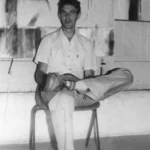
A student of the arts . . .
The photograph above was taken in 1980, my final year at the Natal Technikon, Durban. The larger painting in the background reflects the influence of Richard Diebenkorn.
I love studying the techniques of history’s great artists – Rembrandt, Homer, Monet, Hopper, as well as many more recent artists like Odd Nerdrum, Burt Silverman, Alex Kanevsky. There are so many great artists, internationally and locally, from who we can learn.
Portraiture has been a particular challenge as it’s not a genre included in my studies. The landscape of the human form and face is imbued with so much beauty, colour, depth of character and experience. The palette of the human skin is intensified as light and shadow play over, in and through it – seriously challenging to paint.
My portraits open up for me an opportunity to really get to know the subject intimately visually; it is as if I have known the person for years and the process becomes almost uncomfortable as I become intimately familiar with their character as I explore their facial form through paint. Faces expose so much of who we are and our life journeys – beautiful.
